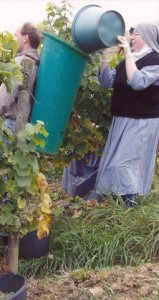
 „The monks [and the nuns] shall live by the labour of their hands“ is what St Benedict laid down in his rule. Our work, therefore, is to support the community on the one hand and on the other it has an important function in spiritual life. „Ora et labora“ – prayer and work form an inseparable unity.
First and foremost in a convent of 56 nuns (comprising five generations), 8 employees and an average of 20 guests, there is of course all the necessary work to be done which involves running a household and organizing the daily life of a community: work in kitchen and laundry, growing fruits and vegetables, taking care of the grounds and buildings, sewing and wood working. There’s also the infirmary and the administration office.
Many of our sisters lovingly perform their daily duties in all of these areas with tireless dedication. Especially those tasks, which on the outside seem rather nondescript, are the ones that support the community and profoundly hold it together. In this, a Benedictine community resembles a traditional extended family with all the daily chores and cares. In accordance with the traditions of our abbey there always are some nuns who devote their time to scholarly research on St Hildegard. Sisters of our community critically edited the main works of our convent’s patron saint. Based on these editions, further individual research work is beginning to take shape now.
Some other sisters attend to groups of visitors and Hildegard pilgrims all year round and give talks about Hildegard’s life and work or about our Benedictine life. From its earliest beginnings, monastic life was also associated with apostolic work. Recalling these old traditions, our community was able to respond to inquiries and meet new challenges in recent years. Three of our sisters are now working in pastoral care.
One is in charge of pastoral care at St Josef’s Hospital in Rüdesheim, the second is a spiritual director to Catholic chaplains in the German armed forces, and since July 2002 the third is responsible for the care of pilgrims to the shrine of St Hildegard in the former abbey church which is now the parish church of St Hildegard at Eibingen.

Le Combat perpétuel entre le Bien et le Mal
Hildegarde de BingenL’Univers (le Cosmos), Œuvre de Dieu
Hildegarde de BingenSon écriture cosmogonique puissante laisse resplendir l’univers au lecteur comme Œuvre divine. La puissance de l’Amour de Dieu est à l’origine de la Création, de l’Incarnation en la personne de son Fils, de la Rédemption des péchés du monde à la fin des temps, embrassant tout l’univers en une seule unité. L’homme apparaît comme un microcosme reflétant, à travers sa condition physique et spirituelle, l’ordre du cosmos entier, du macrocosme. Dieu a donné une forme humaine à chaque élément de la Création. Weiterlesen
L’Union du Salut et de la Guérison
Hildegarde de BingenCelui qui reste sourd à l’appel et abuse de sa liberté dans l’illusion d’une autonomie absolue tombe dans le péché et la culpabilité, provoque un dysfonctionnement d’ordre physique et spirituel entraînant par la suite un désordre des éléments du cosmos. La guérison du corps et de l’âme ne peuvent venir que d’un rapprochement de Dieu, de la foi qui engendre les bonnes actions, un équilibre de vie qui rend corps et âme à nouveau sains. Weiterlesen
La Puissance de la Vérité sans détours, ni apparats
Hildegarde de BingenOur Monastic Vows
Monastic Life at our AbbeyWe do not strive to change our environment nor the external circumstances, but ourselves. With the vow of conversion of manners („conversatio morum“) we promise to live a life following the Gospel. God’s call to every Christian to be ready on an ongoing basis, to rethink and to change one’s ways is meant here.
Such a call is also an ever-new motivation, not to despair in the face of one’s own weakness, but to be prepared tirelessly to start anew. With the vow of obedience („oboedientia“), which the Benedictine takes, we enter knowingly and voluntarily into a dependency on other people, believing that we will encounter God’s will in this way.
Obedience out of love for Christ and as his disciple protects against being trapped in one’s own ideas and whims and from revolving only around oneself. By a readiness for dialogue, by listening and by being responsive to the directions of another, we make every effort to be open to God and to fellow human beings.
Our Prayer
Monastic Life at our AbbeyThe psalms are of fundamental significance within the Divine Office. All human feeling and experience find expression in these Old Testament songs and prayers in a singular way: praise and thanksgiving, remembering God’s deeds of salvation, trust and joy, longing for God, pain, lamentation and intercession. In this way all adversities and joys of the world, but also specific personal concerns of those close to us are brought before God.
Our Work
Monastic Life at our AbbeyFirst and foremost in a convent of 56 nuns (comprising five generations), 8 employees and an average of 20 guests, there is of course all the necessary work to be done which involves running a household and organizing the daily life of a community: work in kitchen and laundry, growing fruits and vegetables, taking care of the grounds and buildings, sewing and wood working. There’s also the infirmary and the administration office.
Many of our sisters lovingly perform their daily duties in all of these areas with tireless dedication. Especially those tasks, which on the outside seem rather nondescript, are the ones that support the community and profoundly hold it together. In this, a Benedictine community resembles a traditional extended family with all the daily chores and cares. In accordance with the traditions of our abbey there always are some nuns who devote their time to scholarly research on St Hildegard. Sisters of our community critically edited the main works of our convent’s patron saint. Based on these editions, further individual research work is beginning to take shape now.
Some other sisters attend to groups of visitors and Hildegard pilgrims all year round and give talks about Hildegard’s life and work or about our Benedictine life. From its earliest beginnings, monastic life was also associated with apostolic work. Recalling these old traditions, our community was able to respond to inquiries and meet new challenges in recent years. Three of our sisters are now working in pastoral care.
One is in charge of pastoral care at St Josef’s Hospital in Rüdesheim, the second is a spiritual director to Catholic chaplains in the German armed forces, and since July 2002 the third is responsible for the care of pilgrims to the shrine of St Hildegard in the former abbey church which is now the parish church of St Hildegard at Eibingen.
The Abbey Shop
Monastic Life at our AbbeyThe Arts and Crafts Workshops
Monastic Life at our AbbeyOur restoration workshop for papers and documents from ecclesiastical archives restores old manuscripts, incunabula and books. The workshop was established and equipped in 1973-74 at the request of the German Bishops‘ Conference and works exclusively for the diocesan archives of the 23 German dioceses. Unfortunately we are unable to take on private restoration work, but would be happy to give advice and refer you to other restoration experts.
The Abbey’s Guest Quarters
Monastic Life at our AbbeyPeople of the most diverse origins meet here in their mutual search for the sources of life. Whoever comes here can, within certain limits, join us in our monastic daily rhythm for up to one week, in exceptional cases even a little longer. One of our sisters would always be available to lend an ear for counseling.
The daily rate for overnight accommodation and three meals is € 65.00 Euro. Should you be interested in staying as a guest, you can contact us by letter, fax or e-mail.